Background
Many months ago I was involved in discussions on platform strategy. One thing which was evident (to everyone) during these discussions is that the word platform meant different things to different people. So it was important to distinguish the different meanings and first agree on what do we mean when we use the word. I spent some time to read up and then wrote this summary (of my understanding) to help bring clarity.
Goal
Provide a clear and concise definition (single page for each) of what constitutes a “platform” to service outside-in and inside-in requirements and include key components.
Note: Before getting to the definition, it is critical to understand that “platform” is an overly overloaded term and there is not going to be any one definition which is going to reconcile all different views and usages that exist. Therefore, it’s better to call out the different definitions that we care about (relevant to us) and give them distinct names that disambiguate them in subsequent discussions.
In our usage of the word platform, we need to understand 2 definitions, the differences between them and the context in which they are talked about.
The first one is Platform as in Platform Business and the second one is Platform as in Technology Platform.
Platform (as in Platform Business)
Platform is:
-
a deliberate construct which enables and entails value creation by participants not limited to the creator of the platform.
-
a vehicle which enables and empowers flow of value between participants other than the creator of the platform.
-
any resource that can generate many-to-many connections for value creation and exchange. It has ability to unleash network effects.
Platform offers opportunities to co-create Shared Purpose, which is the larger intention that the platform owner and all stakeholders are working toward together.
To qualify something as a platform we need to know the shared purpose, value that is co-created and flows through the platform, the participants and the (potential/real) network effects.
Wikipedia example:
Shared purpose - Unlock the world’s knowledge
Participant – Everyone who has internet access and wants to receive or share knowledge
Platform - Online encyclopaedia
A platform business is a business model that enables value exchange scaled by technology and ecosystems. The value created and exchanged could be:
Things, Services, Ideas/IP, or Connections.
The technology that enables platform business models is sometimes referred to as a digital platform and has one or more of the following components:
Content, APIs, Processes, Products, Services, Integrations, Marketplace, Algorithms, Data and Analytics, Reviews/Certifications etc.
The digital platform provides the flexibility to quickly connect information, applications, stakeholders and processes to execute digital business. Note: The digital platform is the technological side of the platform business and has no existence and relevance in the absence of platform business. That’s why it is not called out as a 3rd distinct type of platform here.
Note: When a business leader says move from Product to Platform, most likely (s)he is referring to the move to platform business. The platform business worldview will generate outside-in requirements.
References:
-
https://www.digitalfluency.guide/platforms/from-pipes-to-platforms
-
https://www.digitalfluency.guide/platforms/the-power-of-platforms
-
https://www.digitalfluency.guide/platforms/apply-platform-thinking
Platform (as in Technology Platform)
Technology Platform:
-
provides building blocks or services that are reused to build other products/services.
-
are not two-sided markets.
-
generate revenue/value proposition by selling/providing their services to developers and are typically invisible to top-level users (end users).
In this type of platform, there are no implicit network effects. These platforms grow with favorable reception by developers and do not rely on interaction between demand side and supply side.
They solve recurring problems once for all and in a unified way. The same/similar value flows from the creator to all consumers who have same/similar needs. So, it’s one-to-many and not many-to-many.
To qualify as a technology platform, it needs to be a technology which allows for creation of technology, provide uniformity of tools and experience and result in reduced time to market**.**
A technology platform will have the some or all following components:
Services, APIs, Frameworks, Libraries, Documentation, Processes, Forums, Governance etc.
Note: When a business leader for example says move from On-Prem to Cloud, the mandate will indirectly impose creation of one or more technology platforms to achieve uniformity and velocity. The technology platform worldview will generate inside-in requirements.
References:
Putting it all together
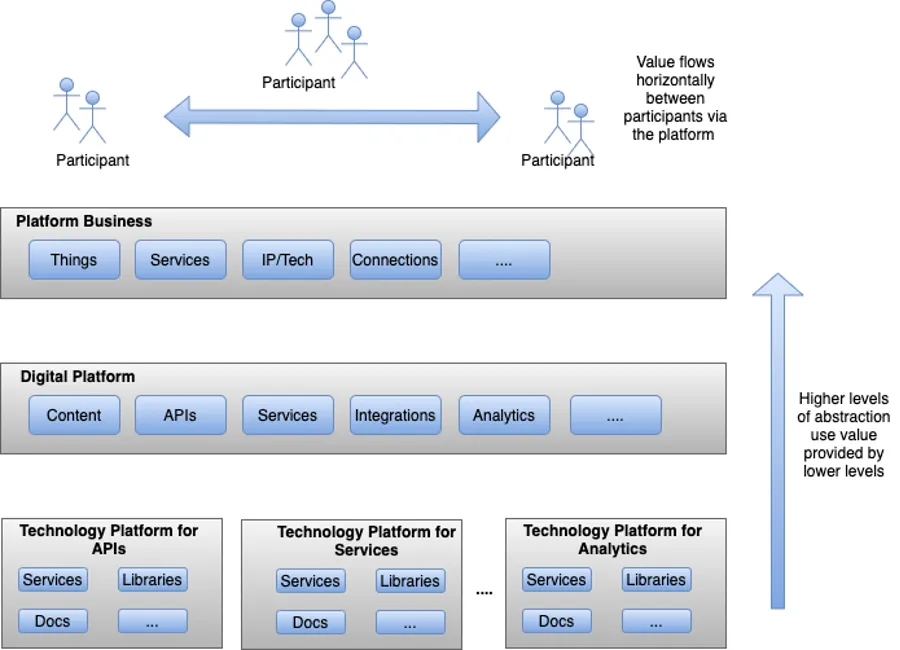 Figure 1 – Platforms demystified